
Training Practices

Studious Golden Lab

Training Practices

The Case for Day Training

We trainers often feel frustrated by unfinished cases and low client compliance—endemic issues in our industry—leading us to describe owners as lazy, uncommitted, unskilled, uncaring, cheap. Alternately, we internalize the failure and blame poor results on our own shortcomings. Neither explanation is fair nor helpful. We have learned to stop blaming the dog and just get on with training him. It’s time to leave behind feeling guilty and reproaching clients, pinpoint the true problems, and focus on solutions.

day trainingCoaching is the Culprit
The heart of the trouble is our coaching approach, our religious insistence on training people to train their own dogs. The concept sounds so right—of course owners should train their dogs, they’re the ones who live with them! But let’s step back and consider the practicalities of the idea and re-examine what our clients really need to know to live successfully with their dogs.

First, let me be perfectly clear: Anyone who knows my work in public class curriculum development and teacher instruction knows I’m adamant about giving owners the skills and knowledge to succeed at home and out in the world on their own. I am not advocating a return to past ages where we took dogs into kennels for two weeks and returned them ‘trained.’ I am advocating an approach that takes into account the realities of clients’ lives.

Why Coaching Fails Us
Coaching—most often a one-hour session once per week in which the trainer instructs and coaches the client on the training they are to do on their own in the intervening week—places too great a burden on the dog guardian. Yes, they should take responsibility for the animals they have brought into their homes. Yes, it would be ideal if they were to become enthusiastic hobby trainers. But in reality most owners lack the skills needed to do much of what we ask of them in an effective and expedient way. Nor are they interested in acquiring those skills. Clients don’t want to be dog trainers, that’s not why they call you. They’re often asked to form entirely new routines—to add time into an already crowded schedule of obligations, to learn and incorporate very different ways of interacting with their dogs, to do things in ways opposite to their habits. If you’ve ever changed a routine yourself or read data about humans and habits you’re aware of the magnitude of such a request and the low success rate to expect. For the client the efforts often result in embarrassment or feelings of failure. No one wants to tell the trainer they haven’t done their homework. Some clients cancel or postpone appointments to avoid it.

Other guardians turn their frustration on the trainer or the training methodology—it’s not working, ergo the trainer is incompetent or this positive humbug doesn’t work. It certainly can appear so. We’ve all heard the allegation that positive reinforcement is slow. Which is untrue—in skilled hands positive training is elegant, effective, and swift. But our clients’ hands are not skilled. In their hands, with our weekly coaching, progress must feel slow indeed. And a lack of progress dampens motivation for humans just as it does for dogs. Nobody wants to play a losing game.

Your Livelihood—And Everyone’s Reputation
Coaching in most cases is a lose-lose-lose proposition.
It frustrates owners, leaves dogs without the help they need, and negatively affects trainers and the training profession. We argue for professional status while claiming we can teach clients to do the work themselves in 60-minute sessions once a week. If dog training is indeed so easy, why all the money and time spent on dog trainer schools, books, DVDs, mentoring, and certification exams? What other profession surrenders authority in such a way? Imagine a lawyer handing over case notes and encouraging you to argue your own case because, after all, you’re the one going to prison if it doesn’t work. It’s no surprise that we encounter clients who believe they know more than we do or who argue with us over methodology—we do not behave as though we hold the professional knowledge and skill set that we each work so hard to attain.

Coaching is bad business. Money is lost every time a case—obedience or behavior—is left unfinished, and poor word of mouth follows. When training isn’t finished old behaviors eventually resurface and new ones inevitably go on the decline, prompting clients to say “Well, we hired a trainer and it sort of worked for a while, but he’s still jumping all over people,” instead of “We worked with an amazing trainer, it’s completely changed our lives. Let me get you her number!”

Coaching is hard to sell. “We train you to train your dog!” is a terrible marketing message. People don’t want to pay money to be shown all the work they themselves need to do. Other common lines are “We’ll improve your relationship with your dog” and “We’ll teach you to understand your dog so you can give him what he needs.” Terrific marketing if your audience is other positive reinforcement dog trainers. But most owners don’t call a trainer because they’re concerned about their relationship with their dog or because they want to hear that everything going wrong is their fault—if they just understood the dog and provided properly for him everything would be fine. They call trainers because they have one of two problems—either the dog is doing something they don’t like or not doing what they want. And without an effective marketing message centered around solutions we’ll never have the opportunity to help improve those relationships and get dogs some understanding. Compulsion trainers, franchise chains, and TV shows compel so many owners not because guardians want to harm their dogs, but because these training outfits know how to market—they understand the desire for easy, swift resolutions.

Alternatives to Coaching
Can we offer clients an ‘easy’ button? Of course not.
But we can do better than offering to teach them to do all the work themselves. We’re professional dog trainers, after all—it’s high time we started training some dogs.

One way is day training. The trainer trains the dog in the owner’s home then teaches the client the necessary skills to maintain the training for the long haul. A typical day-training program consists of an initial consult and then a number of weeks (determined by the trainer based on the needs and goals of the case) in which the trainer sees the dog several times, wrapping up each week with a transition session to show the client what Fido has learned and to ‘proof’ or transfer the training to the owners, including teaching them how to ask for and reinforce new behaviors, and what to do if they don’t get a requested behavior or if they experience an unwanted one popping back up. After the designated number of weeks, the package will also include some number (usually 1 to 3) follow-up sessions scheduled as needed to ensure long-term success.

On a side note: Don’t rule out board & train. Board & train has had a bad reputation among many positive reinforcement trainers for historical and philosophical reasons, but with skillful transitions and follow-ups built into board & train packages this can be an effective and lucrative approach as well. And though I share some trainers’ affront that owners would, as one trainer recently put it to me, “shove their dog off to a stranger as if it were a car that needed repair,” some owners really do find themselves at wits end and unable to cope. If you can train someone’s dogs and then show her how to protect that training, the relationship between dog and owner, and the way the owner feels about her dog, is likely to greatly improve. The dog can only benefit from that.

Day Training: A Triple Win
Day training sets up owners, dogs, and trainers to win.
Cases are seen through to full conclusion—owners reach their goals, trainers experience the satisfaction of a completed case, and dogs get the help they need. The results owners witness in the transition session at the end of the first week translate into high levels of compliance. Why? Learning maintenance skills is far easier than training from the ground up because the dog already knows his part and the clients are strongly motivated to protect the progress they’re so delighted to see. Such achievements make buy-in for methodology easier to get. Many clients also love the convenience of having the training done during the day while they’re at work.

Day training is easier to market. You’re now able to offer convenience, expediency, and customized solutions for busy lives, all hot selling points in today’s marketplace. As one dogbiz client recently said to me, “It’s a lot easier to ask for money—and clients are much happier to give it—when I can offer to do the training for them!” Another advantage is that you need far fewer clients when you day train. Because each owner means an average of four sessions per week, day training earns you the same amount of money with roughly one quarter of the clients.

Coaching still has its place, primarily for issues demanding high levels of management such as housetraining, destruction, counter surfing, and the like. Coaching may also be necessary in cases where a dog is too fearful to work for you, at least until enough of a relationship can be built with the dog to allow a switch to day training.

Personal Trainer vs. Dog Trainer
R+ trainers need to move away from being personal trainers shouting words of encouragement while clients struggle under the weight of training their own dogs. It’s time to be dog trainers, doing the work that trainers are called for, hired to do, and for which they have the professional knowledge and skills. To do so is kind to owners, good for dogs, and a huge relief and opportunity for dog trainers. Strong teaching and people skills remain critical to success, yes, but what a joy to get to train dogs, see owners meet their goals, and know that you’re improving the quality of dogs’ lives, all while expanding your own income potential.


If you’d like to learn how to add day training services to your biz, check out dogbiz University’s Mastering Your Day Training course.

Better Case Resolution

Two hands, one passing a baton to the other.In our one-on-one work with trainers we are often asked to help bring down the number of unsolved behavior cases—by which I mean those clients a trainer sees once or twice, maybe more, without resolution. In such cases clients don’t meet their goals, dogs are not helped, and business suffers. I have said in past columns that you cannot start and build a business on word of mouth alone, and that is true, but having a strong reputation is nonetheless important. Bad word of mouth can really hurt a trainer. Each unfinished case means another dog owner who possibly says, “Well, I tried using a trainer, but it didn’t really work,” instead of “I hired a trainer and the change in my dog’s behavior was amazing. Here’s her number, you have to call her.” Another concern with unfinished cases is the degree to which they contribute to burnout—few things are more discouraging than knowing you could have helped a dog but not having the opportunity to do so.

What, then, can raise a trainer’s volume of unfinished cases? Blame a near-universal discomfort in closing sales for larger packages, or even the outright lack of training packages in place of week-to-week sessions. Also, the scope of the training plan itself can be the problem. Enamored as trainers are (and rightly so) with learning theory and technically correct solutions, they often forget that successful pet dog training rests upon pet dog owner training. Behavior modification plans have to fit into clients’ daily lives in order to be successful—don’t ask or expect the average client to rise to your level of skill or interest in training. Just as with dogs, set your clients up for success by working at their level. A number of guiding principles help in this work.

Don’t Over-Train
Unless safety is at stake, don’t insist that owners do more than they want or need. With his or her extensive knowledge, the trainer always sees the potential in a dog. He knows just what he would do if the dog were his, and this can bring him to push further than a client may be interested in or really need.

Say a retired couple lives in the countryside with their dog, who is fearful of children. If the dog’s only contact with kids is a yearly visit from the grandchild, the couple may feel frustrated with an extended desensitization and counter-conditioning program and eventually let the training fall by the wayside. Instead, a good management plan for that one weekend of the year will serve everyone—the clients, the dog, and the trainer.

Similarly, consider the different needs of two households with food resource guarders—one, a professional couple with no kids, another a busy family. While the latter calls for full treatment along with careful management, the professional couple may be perfectly happy following a work-to-eat regime while they’re at work, and crating Fido when he has chews. Don’t forget obedience issues, too—there are times to teach a nice heel or loose-leash walking and times when an anti-pull harness or head halter more than meets a client’s goals.

While you may not have as many sessions with management clients as you would with full treatment, you will receive the clients’ good will and potential referrals. Also, the success they experience with your instructions means they’re more likely to call you back for other needs now or in the future.

Help Clients Set Realistic Goals
Sometimes clients are the ones who overshoot. When a client comes to you hoping for quixotic results, catering to their fantasy goal, even if you do so with the best of intentions, only sets everyone up for failure. Don’t be afraid to be straight with clients about what is possible and what is not.

Start by getting at the heart of what a client wants, then help them to reset their expectations. What does ‘problem fixed’ really mean to them? For example, a Papillon pup going 8 hours without relieving herself is not an achievable goal. But if you push and find that the central issue isn’t so much that the puppy is peeing (“It’s a puppy, after all,” the owner concedes), but rather the damage to the client’s home, you can put together a plan for housetraining that includes immediate rug protection.

Once you know what the owner wishes for, balance wants with needs. A client who dreams of a flawless recall must devote the resources necessary to meet this goal. Does she have the time, skill, money? It is your job to make sure. If you see a disconnect, help rescale her definition of ‘problem fixed’ to match what she realistically can achieve. Often, this is a good time to think in terms of management. If an owner will have just the one Saturday walk each week to practice recall, a long line would allow for greater freedom to exercise outdoors in the meantime.

The goals of owners are frequently based on what they feel is expected dog behavior. A complaint about an adult female refusing to play with other dogs at the park does not require training but education. Once your client knows the behavior is common, even typical, she no longer feels her dog is acting inappropriately.

Develop a Human Training Plan, Too
A solid behavior modification plan is all well and good, but don’t forget to design a training plan for your human clients. What skill sets and knowledge do they need, and in what order, to successfully train their dog? (Or to maintain training already learnt.) What are your goals for the client, and what will you be reinforcing? What are you willing to overlook? Remember, your client does not have to be a professional trainer—he just has to be able to meet his specific goals. Armed with answers to these questions, write up a series of exercises to set your client up for success.

Treat The Humans as Well as You Treat The Dogs
One great thing about positive reinforcement training is the attitude it engenders toward dogs. When they do something we don’t like (or don’t do what we want them to), we don’t think them bad or stupid or willful. We simply lay the problem out: The dog is doing X; I want him to do Y. What will I do to help him be successful? I love this problem-solving, blameless approach. It is kind and effective.

When it comes to human clients, rather than jumping to value judgments—the owner is ignorant, uncaring of his animal, purposefully wrongheaded—apply the same thought process you would for a dog. The client does X; I want him to do Y. Or: he believes X; I want him to understand Y. What will you do to help him succeed? This is part of your human training plan.

Practice patience, just as you would with dogs. Changing and proofing behavior takes time and this is particularly true of the human species, so build in benchmarks to remind yourself and the client of progress made. Praise anything you like, ignore or redirect what you don’t.

Don’t Under-Train Your Clients
Yes, you want to simplify where possible, but don’t under-train either. After the initial consult, the majority of each session should be practice time for the client so she can benefit from ample feedback and build strong muscle memory. It’s crucial to see fluency at each step before moving on. Skills and knowledge built on shaky ground set clients up to train poorly on their own. If an owner is not mastering a certain skill or exercise, take a page from Bob Bailey and simplify what you are asking for by breaking it down into smaller steps. Always be willing to adjust your human training plan, just as you would with dogs. If even a solid ‘sit’ isn’t happening, reassess, and, depending on the situation, consider working on timing exercises without the dog, simple luring practice, exercises to build dog-client focus, or whatever other baby steps might be helpful.

Use Tracking Tools
Tracking tools, such as progress charts or logs, can be useful in keeping clients focused and may save you a great deal of time. Ask clients to keep track of data you want them to focus on. For a tough house-training case you might have the client write down the number of indoor accidents, rewarded outdoor potties, and unrewarded outdoor potties. This serves as a reminder that she is supposed to reward outdoor eliminations. It also provides you with data that would otherwise have to be collected through careful interviewing. If you see that very few eliminations were rewarded in the yard, you have your likely culprit for slow house training and know where to redouble the client’s focus. If the problem continues, reassess the situation to learn what is making it difficult for the client to take advantage of the outside potties, and find a new solution.

Try a Universal Cue
One solidly proofed behavior is worth ten that require a treat in the hand. Consider whether your and your client’s goals could benefit from a universal cue. Trainers are fond of teaching multiple commands—sit, down, stand, leave it, stay, watch, let’s go, come, wait, and so on. But, and perhaps you have come across this phenomenon, private and public class clients often settle on one cue and use it for everything, gravitating toward whichever command their dog does best. The reinforcement provided by the dog’s compliance lead them to use and more heavily rely on that particular behavior— an example of operant conditioning at work. A trainer’s first instinct is often to correct this, to insist on using ‘leave it’ for leaving it and ‘wait’ for wait, ‘stay’ for stay. The thing is, these universal cues actually work well for many people.

Few dog owners hire trainers with anything as grand as ring obedience in mind, or anything else, for that matter, that requires adherence to strict rules. So let’s break them. If a dog has a jumping problem, why teach ‘sit’ and ‘off’? A strong ‘sit’ does the trick, since sitting and jumping at the same time is a physical impossibility. Sitting is also an effective incompatible behavior to lunging and other undesirable activities. ‘Let’s go’ and ‘leave it’ are excellent universal cues—you can use either one for not picking up trash on the ground, not lunging or moving towards another being, breaking attention and redirecting it to yourself, etc. They can be powerful commands in working with everything from dog-dog aggression to poor focus.

A universal cue means that there is only one thing for owners and dogs to learn and practice, resulting in stronger, more reliable behavior from both the client and the dog. And owners are more likely to experience success with training.

The Final Word
Ultimately, it comes down to this: Too many unfinished cases can stymie a business. Which is why devising training plans that takes into account the client’s goals as well as the reality and restrictions of her life is a win-win-win: for the clients, the dogs, and your business.


Mastering Client Paperwork

Woman at a desk writing on a notepad.If only it were just about training the dogs! But of course it isn’t. Many other responsibilities, tasks, and details vie for a dog trainer’s attention. Client-based paperwork is not the least among them. Interview forms, write-ups or reports, homework sheets—dog trainers spend more time at their desks than people might think. I often work with my dog trainer clients to make the most of these tools while minimizing their impact on that most valuable of resources: time.

Pre-Consult Questionnaires
There are compelling arguments both for and against requiring clients to fill out questionnaires prior to a first appointment. It’s important to understand the implications so you can make the right decision for your business and clients.

Questionnaire Pros
Many trainers find that questionnaires decrease the feeling of walking into a new situation blind. It’s a way to gather more information about the dog, family, and training or behavioral issues before the initial consult, without having to spend additional time on the phone. This also means being able to prep more fully for the interview, and a somewhat lower likelihood of being surprised upon arrival with a problem you weren’t aware of or prepared for.

Some trainers cite screening for client compliance as reason for requiring questionnaires. The logic goes that if a potential client isn’t willing to answer a few pages of questions they’re not likely follow training directions and get their homework done.

Pre-consulting paperwork also creates a record of the dog’s issues in the client’s own words and hand. Should you ever need it, you can prove what was and was not accurately reported to you.

Questionnaire Cons
The biggest drawback to asking clients to fill out paperwork before they can see you is that it might result in their not seeing you. From a business perspective, you generally want access to your services to be as easy as possible. A questionnaire can act as a roadblock. By asking clients to jump through any hoop, however potentially beneficial, before they can gain your expertise may not serve your business, the client, or the dog. Should a client be put off by the request, or should they simply procrastinate or, like most people these days, be terribly busy, you stand to lose business. And the client and dog fail to get help.

It also does not necessarily follow that not completing a questionnaire indicates a lack of future training compliance. While it’s true that past behavior is generally a useful indicator of what to expect next, a logical case has not been made between filling out paperwork and doing one’s training homework. First, these are two different kinds of tasks.

Secondly, it is part of our job as trainers to create compliance—by inspiration, by designing training plans to fit our clients’ lifestyles, by creating results—and we can’t very well do that if we aren’t working with the client because they didn’t fill out paperwork. (Interestingly, there is not a correlation in the opposite direction, either. I don’t think we can make the claim that a willingness to fill out a questionnaire predicts good homework compliance.)

In short, you may actually be weeding out wonderful clients who just didn’t, for whatever reason, care to jump through the questionnaire hoop.

And while the information on a client questionnaire may give us more to prepare with, it cannot be considered fully reliable. It will still be necessary to undertake a client interview to flesh out answers and gain a full picture of the issues at hand. Given this, it may not be a true time saver for trainers, and may be a source of irritation to clients having to answer a question they’ve already written about.

So, should I use one?
That depends. If your business is thriving and you’ve got a waiting list, then maybe. A questionnaire in this case may help weed people out. It’s not that those who didn’t fill it out would have made poor clients. It’s just that you’re busy enough that losing some potential sales to the paperwork requirement is actually helpful.

If your caseload includes a lot of serious aggression cases, a questionnaire may provide extra liability and safety protection for you by providing a written record of what the client did and didn’t reveal to you, and you have additional information to use in deciding whether to take the case. Alternatively, however, you could have them sign off on your notes from the initial consult.

If you tend to be nervous about approaching new cases, and having the additional information from the questionnaire makes you feel more comfortable walking into the initial consult, it may be worth risking the downsides until you’ve built your confidence up. But no matter how well developed and detailed the questionnaire is you should still be ready for the unexpected. Clients don’t always prioritize, see, or understand things the same way we do so some surprises are inevitable.

The majority of trainers do not need to use a questionnaire and may be ill-served by asking clients to take additional steps before gaining access to training.

If you use one.
Short of the exceptions above, if you use a questionnaire make it optional rather than mandatory, to avoid losing a potential client’s business.

Keep it short, easy to fill out (use check boxes wherever feasible), and on topic. Avoid asking questions that are not useful for assessment or prognosis.

Write it for description instead of interpretation. Description—what the dog does and when he does it—is more useful than the client’s interpretation of what he’s doing or why. (A client’s perspective is important to know, but easy to get. They’re likely to share it on the phone, in the questionnaire, at the initial consult. What’s harder to garner is what is actually taking place.)

How you ask a question can be the difference between getting an answer like, “I think he was mad because I’d been away for three days” and “I took his pig’s ear and he bit my arm.” Clearly the second is of much more diagnostic use. To get descriptive answers ask questions like “What does your dog do when you…?” instead of open ended questions such as “What happened?” This is another place check boxes can be helpful.

Post-Consult Reports
Some trainers give clients post-consult reports, some do not. Some do so only after the initial consult, while others put a write-up together for each session. There are no hard and fast rules here, nothing professionally required. But here’s what we recommend:

Produce a short report after each initial consult. This is particularly important for aggression cases in order to have a written record of your assessment and recommendations. But it can also be helpful to you and the client for any kind of case. Clients can be easily overwhelmed by the information given them in a typical appointment. Having something to refer back to can help to reinforce the main ideas and keep them on track over the coming week.

In addition to liability protection, your reports can be used as a marketing tool. With your client’s permission, send a copy of each report to the client’s veterinarian along with a cover letter. Your reports can convey your professionalism and expertise better than any brochure or flier possibly could. I’ve seen many trainers gain new referral sources with professional reports—even vets adamantly committed to a different trainer or who refused to give any referrals at all. (Vet reports needn’t be limited to behavior cases—use them for obedience and manners work, too.)

Keep your reports short. Really short. No more than two pages, with plenty of white space. Clients are much more likely to read and use what you give them if it is not overwhelming. Veterinarians are much more likely to read it if it is brief. And you will spend much less time at your desk and thus more time marketing your business and seeing clients if you are not writing training novels.

Keep your reports to the basics—assessment of areas of concern, prognosis, management recommendations, and a basic outline of the training approach. This is absolutely not the place to lay out the training plan in step-by-step detail. Doing so can not only intimidate clients, but sometimes give them the impression they could maybe try it on their own—without you. This is not only bad for your bottom line, it sets the client and dog up to maintain the status quo they called you to change.

Write-ups after each session are a good idea in aggression cases in order to maintain a strong paper trail. For other situations, homework handouts will do the trick.

Written Homework
Having a written version of their homework after each session is helpful for most clients to refer back to. But there are also some pitfalls to avoid.

Keep homework write-ups short and to the point. One to two pages maximum, with plenty of white space. Use numbered lists, bullet points, and section titles to make the handout easy to read and use. Avoid the inclination to include essays on learning theory, training techniques, and so on—these sheets are for lay dog guardians, not fellow trainers. (It’s not that understanding basic learning and training principles isn’t important—just keep things brief, simple, and immediately applicable to the week’s goals.)

Whenever possible use pre-written, standard homework handouts to save yourself time. You can personalize standard templates for a particular client if need be, but stay away from writing up unique pieces for each client after each section—this is not sustainable for a thriving business.

Give clients only those handouts that pertain to the topics you covered. You may be tempted to share all the handouts in your repertoire, but don’t. Less is more when people are learning something new. Don’t overwhelm or distract clients with additional information when you want them to focus on their instructions for the week.

General Advice

Brand, brand, brand.
Everything you hand clients should be branded with your business name, logo, and contact information. Visual consistency is key—all your written material should be easily recognizable as coming from your business. Use the same colors and fonts (and keep both to a minimum), and standardized layouts.

Standardize.
Use standard versions or templates for all your paperwork to work as efficiently as possible.

Less is more.
Avoid long versions of anything when a short version will do. Remember that most clients are not behavior and training junkies. They are typical, busy, stressed people who need help with something—in this case, training their dog. They are not looking to become professional trainers or gain a thorough understanding of learning theory and dog behavior. They just want some effective relief. Dole out the information you think is critical in small enough batches that they can take it in and act on it. This might be different for each person, and occasionally you’ll get a client who is hungry for every bit of reading material they can get their hands on, but for most people less truly is more.

Choose wisely.
There are no rules here—no governing body to tell you what paperwork you must use when. So think about your goals for clients, for your own time, and for your business. What paperwork best suits you, your business, and those who have called you for help?


Make quick work of your paperwork by letting us do the work for you. Save time with the editable, brandable Business Toolkit for Trainers.

The Business of Curriculum

Frustrated at classes that end with fewer students than you started with? Disappointed that more clients don’t sign up for the next round? All the more perplexed because your class evaluations are glowing, your rates competitive, your reputation strong, and your class schedule full of choices?
Jack russell terrier dog wearing glasses appearing to work on a laptop computerMore often than not the problem is the curriculum. The best classes focus on human decision making, not dog performance, and curriculum should be designed with this in mind. Concern over whether every dog in a class can do a five-minute ‘down stay’ by the end of the course misses the point: What a dog can and cannot do in the classroom is not important—he doesn’t live in the classroom.

The key to reducing recidivism and increasing subsequent class sales is the real-life impact of your classes. No matter how much fun students have had, no matter how much they like their instructor, now matter how successful their dog was in class—if they don’t see useful change in their own lives with their dogs they’re less likely to return.

What every trainer wants—for the sake of her clients and her business—is for the learning and the results to manifest outside the classroom. In other words, clients must learn to make decisions in real-life situations that will help them to a successful outcome with their dog in any particular moment.

Real-Life Success, Not Classroom Performance.
With a curriculum that focuses on the aforementioned five-minute ‘down stay’ in the classroom, that is precisely what the client gets (if, that is, she is very successful): A dog able to do a five-minute ‘down stay’ in the classroom. That isn’t very useful. By contrast, if the client learns what motivates and distracts her dog, and how to accurately read a situation, she will be able to make decisions that set her dog up for success out in the world.

Say a student walks with her dog to a nearby café on a Sunday morning to get a bagel. She wants to eat her bagel on the café patio in the sunshine. A student taught decision making would look around for potential distractions and challenges for her dog in this environment. She would then decide a) whether it is realistic for her to sit and enjoy the sunshine, and b) if she thinks it is, where she should sit, what she needs to watch out for, and what she is asking her dog to do. Is it reasonable to ask her dog for a ‘down stay’ or will she accept a ‘sit’? She would also decide what she is going to reinforce the dog for and at which frequency, what it is reasonable for her to expect from her dog if a distraction enters the environment, and how she will react. Are there circumstances under which she will get up and leave—that is, before a problem arises or she asks too much of her dog?

Rather than insisting on a five-minute ‘down stay’ at the café, this client is making a realistic assessment of what her dog can do in a specific environment so her dog can be reinforced for that. She has learned to assess her dog’s level and work within it so she can expand it, rather than constantly insisting her dog perform an arbitrarily determined behavior based on what was done in class.

To be able to do this, our student had to learn the following: Situational awareness, real-life problem solving, and to work at her dog’s level (criteria setting, essentially).

To teach clients these skills, all curriculum design should be based on two precepts:

  1. Contextual learning. Meaning, don’t teach behavior just to teach behavior. Every classroom exercise should be built around a real-life purpose; no more behaviors taught in a vacuum.
  2. A focus on teaching clients real-world decision making and problem solving. If a client cannot apply what she is learning in class to her life outside the classroom, the class has failed her. From a business perspective, so has the trainer or manager giving the class: When learning has no impact out in the world, people often fail to finish the full course and far fewer come back for another.

Process, Or Fading The Prompt…
Whole books could be written about the process of teaching this type of class. Briefly, here are two keys to success:

A scaffolded approach. A good dog training analogy for scaffolding is fading the prompt. Initially the teacher tells the students what to do. As they pick up the foundational learning, the trainer begins to create opportunities for them to apply their knowledge to new situations, keeping it simple and easy at first. Say the students have just learned how to use a lure to teach their dogs to sit. The instructor might then ask them to consider how they would apply the same technique to train ‘down.’

Or imagine the teacher has explained the principle of ‘nothing for free.’ Instead of giving the clients every example she herself can think of, she gives only a couple and then asks students to find examples each from their own lives.

Gradually, the challenges become larger and more complex, and in the process become increasingly entwined with real-life situations until eventually, the trainer might place the clients in an actual or pretend situation such as a café (or a trip to a pet store or vet office, a mock living room with a ringing doorbell, etc.) and ask them to make the decisions faced by the woman in our opening example. By the end of class, the trainer should not have to tell a client whose dog is easily distracted by other dogs where to sit in this café scenario to create the distance that will allow her dog to be successful. At that point the trainer has faded the prompt and the student is able to do it herself. Failing to fade the prompt greatly decreases the likelihood the client will make good decisions out in the world.

Self-Contained Lessons. One of the biggest challenges facing any teacher, whether they instruct kindergarteners, high schoolers, grad students, or people with their dogs, is handling the widely varied skill and knowledge levels of their students. Do you teach to the middle? Reward the more advanced students with extra time so they don’t get bored? Give the struggling students more of your attention? These questions often spark lively debate, but it’s a false dilemma, because a well-designed curriculum does away with the need to choose.

If we don’t require that all dogs attain the five-minute ‘down stay,’ bell curve grading can be put to rest. Lessons and activities can be designed to allow everyone—humans and dogs—to succeed and improve, regardless of where they currently are.

For example, an alternative stay lesson might consist of a particular distraction set up in an area of the classroom. (Perhaps a guest dog working with an assistant, the instructor bouncing a tennis ball, a student’s teenager rolling a skateboard.)  Students are told to practice stays in the midst of the distraction. The challenge? The students have to decide where in the room to practice. They have to read their dog, judge how he’s likely to react to the distraction, think about how well his stay is coming along, and then decide: Should I get up close and go for short duration? Give myself ten feet? Work in the farthest corner (or even the hallway)?

If their decision is wrong in either direction, they’ll soon know. Early on in the course the instructor might prompt an adjustment: “Fido seems particularly entranced by the skateboard. What might make this easier for him?” This instruction will help the student learn to take action as needed. Again, if we make the mistake of telling the client what to do (“You might want to move farther away from the distraction”) instead of cultivating their own problem solving, the learning is less likely to transfer outside of the classroom.

This lesson allows people and dogs at all levels to participate successfully because success is defined individually. And when I work at my dog’s level he’s able to get it right, which means I can reinforce him, which means he’s going to get it right more often.

The Bottom Line
We often talk about training really being about teaching humans, not dogs. But few training classes realize this conviction. Too often class curriculum is treated as merely a list of behaviors to teach; which keeps the focus on dog performance, not human learning. It’s also not curriculum—it’s a list of behaviors. Curriculum focused on the human learners, by contrast, is built around problem solving and decision making applied to real-life contexts.

We tend to judge the success of our classes based on 1) whether people enjoyed themselves and 2) whether the dogs were able to perform the prescribed behaviors. But a much better yardstick would be how our classes make people’s lives with their dogs better or easier in some way—because that’s what will get them to come back. And that’s good for them, their dogs, and for business.

A Few Additional Tips for Selling Subsequent Classes:

  1. Don’t wait until graduation to tell students about the next class they should take. Instead, talk about upcoming classes and next steps in the penultimate class. This gives students time to think ahead and not feel rushed into a decision. They’re more likely to remember to bring their checkbook or credit card and to be ready to pull the trigger. For an added personal touch, give each student a branded postcard with your personal recommendations for which class or classes would be a great next step for their dog.
  2. Give a discount for registering for a next class at graduation. The discount doesn’t have to be large to work– something as small as 10% or $10 will do the trick.
  3. Focus on the benefits of taking the classes. Talking about what will be covered is fine, but telling people how it will help them—that’s the key. Will the class make life at home calmer? Help them enjoy taking their dog out into the world? Make them feel more in control? Give them an enjoyable way to spend an evening out at half the price of dinner and a movie?


Want some help with your curriculum? Check out these resources:

Learn how to make yours The Best Classes in Town with this dogbiz University course.

Jump start your classes with a dogbiz curriculum package:

Want to read more?

Training the Clients

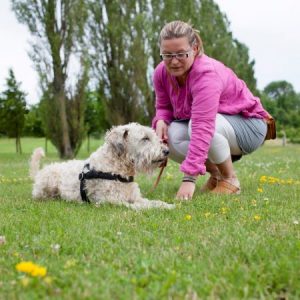
Woman training her dog at the parkMost trainers agree that working with clients is the most important—and most challenging—part of the job. Even when the trainer does the training in board and train or day training situations, the work with the client remains the central ingredient to success. Transferring complex skills and understanding to a human is tremendously more involved than employing the laws of operant and classical conditioning to train a dog. It’s no wonder, then, that it is this part of our work that trainers most often struggle with.

What do they really need to know?
There is a temptation to share everything we know. To take clients on a tour through the learning theory quadrants, explain the process of D/CC in detail, or give them the ins and outs of CERs and DRIs. In short, too often we look to transform our clients from dog owners to junior trainers.

Instead, ask yourself two questions. In order to reach their specific training goals:
•    What does this client need to understand?
•    What does this client need to be able to do?

Your answers will be tempered by the training structure you’re using. Trainers employing the coaching model will necessarily answer somewhat differently than those training for the client through day training or board and train. Regardless, all dog pros should translate their answers to lay language and think beyond behaviors. Does the client need to understand that how often she treats her dog effects his focus on her, or that rewarded behaviors will happen more? Does she need to learn how to handle the distractions that occur all around us? Less really is more here—the more you try to fit in, the less well the client learns each thing.

How will you teach them?
This isn’t a question of how you will explain things. Telling is not teaching. Hearing is not learning. For a client to truly own a new concept or develop a skill means the ability to apply it to new situations without instruction. This requires guided experiential opportunities to use and “discover” the new concepts and skills you wish clients to have.

In our Master the Growlies seminars we walk trainers through a number of ways to create these situations with private clients. The following example could be used in any format (coaching, day training, board and train) to teach clients to work in the face of environmental distraction. In this case we’ll use Watch, but it could be any cued behavior.

The behavior is not the central priority here; handling distraction is the real goal. The behavior is the vehicle to teach this larger concept and skill. But if the larger goal is reached—that the client understands the role of distraction in her dog’s behavior and be able to recognize and respond to it effectively—the behavior is much more likely to be successfully proofed.

  1. Teach the Watch (There are many ways to initially teach or transfer an already installed behavior, but that that is a large topic in and of itself.)
  2. Have the client practice working with the dog in a low-distraction area inside the house. Guide and give feedback until the human-dog team is working smoothly together and reliably getting the behavior.
  3. Move the duo to a somewhat more challenging location, such as a backyard. Don’t talk about distractions or anything along those lines. Just cheerfully suggest moving into the yard to continue practicing.
  4. Chances are the client will find the exercise more challenging in the backyard than in the kitchen. At that point, a conversation about what has made it harder for Spot to respond and why is likely to have much richer meaning than a warning ahead of time. The context of immediate experience creates the basis for understanding, and you can then show the client how to work around distraction.
  5. Once she has her dog’s focus back and is again successful with the Watch, suggest that you now move to the front yard. But this time, before you go, ask your client to name the distractions she’s likely to encounter in the front yard and ask her how, based on the experience in the backyard, she plans to handle the situation.

In moving to the backyard and refraining from initially giving instruction, you create a teachable moment to introduce a concept and set of skills when they are most likely to take hold— in the context of real experience. And in this last step, you begin to hand over the reins. Notice how quickly we’re asking the client to begin making decisions and applying what they’ve learned. It’s critical to begin fading the prompting early on so that clients learn to act for themselves. Without fading the prompt (called “removing the scaffold” in educational terminology) clients are less likely to learn the skills and concepts we wish them to, to be able to apply them when we are not there to whisper instructions at their elbow.

Train for the real world.
We talk a lot in our profession about working at the client’s level and splitting complex mechanical skills down into smaller pieces. We also look to break behaviors down into more manageable pieces for people to work with. These are very important concepts, but we can’t forget in the process of using them that clients live in the real world.

For example, we love the idea of breaking down the Three D’s—distance, duration, and distraction. And we particularly like the notion of training first without distraction, then with a little of it, then a little more, etc. And that is certainly ideal. But dog guardians don’t live in a vacuum. We can’t wait to introduce distraction as the last D, and we can’t afford to assume that clients will always be able to avoid certain levels of distraction until their dog is ready for them. Life’s just too messy.

This is another reason to begin handing those decision making and application reins over early. Think about your sessions with clients as opportunities for discovery and application. Add as many experiential learning moments as you can so that clients are practicing encountering the kinds of challenges that will face them every day when you’re not there to give instruction. Working on Stay? Introduce distraction in the very first session. Show them how to respond. Then toss distractions in when they aren’t expecting it. Prompt as needed in the beginning, but look to fade those prompts quickly. If they don’t respond, waiting for you to tell them what to do, counter with a question: “What could you do next time I drop the tennis ball to help Fido be successful?”

Heavily reinforce all unprompted action. And think about taking your client sessions on the road when appropriate to work in the environments clients will find themselves in over the course of their daily lives with their dogs.

Emotions matter.
Factor client emotions into your training plan, particularly in behavior modification cases. As with dogs, strong emotions like fear can impede human learning and a successful plan must address this.

One of the sample cases in the Master the Growlies seminar is a leash reactivity case in which the client has become so sensitized to her dog’s reactions to other dogs that she has stopped walking him altogether. She’s just too scared to take him out. This is a situation in which day training or board and train is a real advantage. The trainer can work on changing the dog’s behavior, the dog gets out for his walks, and the client gets a needed break. (If coaching, I would recommend introducing some alternative exercise outlets until the client’s skills and confidence are built up.)

In the sample case, the trainer installs some basic behaviors (Sit, Watch, Find It) and then the client works on these at home while the trainer takes the dog for walks to proof the behaviors and work on the classical conditioning portion of the plan.

Very important to the plan is the gradual desensitization of the client to walking her own dog. Over many sessions she is led through steps one at a time. Only when she is ready (noted in this case by a relaxed approach to the activity—a positive Conditioned Emotional Response) is she graduated to the next. She practices with her Fido and a stuffed animal. She watches the trainer handle Fido with a therapy dog so she can see how poised her dog is capable of being. She practices with Fido and the therapy dog as the therapy dog handler.

Only when she is very comfortable does she take up her own dog’s leash with the therapy dog present. And the first time she and the trainer take it on the road the trainer handles her dog for her, narrating her decisions, then asking the client to suggest actions. Finally, she takes the leash with the trainer there to prompt as needed. By this time, however, the client is less likely to require that prompting. As with all other teaching, any prompting should be faded as quickly as possible to engender the client’s confidence in her own ability to walk her dog without the trainer present.

This example shows how central the human teaching plan is to the positive outcome of a case. The dog training cannot be overlooked; without a solid training plan, well executed, the client cannot succeed. But the dog training plan is only half of the picture. A thoughtfully designed teaching plan for the client must accompany it. Because whether you offer coaching, day training, or board and train services, careful attention to teaching people is central to dog training success.